

Your website is not a digital brochure. It is a revenue-generating asset, and the agency you hire to build it will either accelerate your growth or quietly drain it.
The challenge is that every agency pitches the same way. Mobile-first. Results-driven. Transparent. The language is identical across hundreds of firms, which makes genuine evaluation harder than it looks.
Getting this right starts before you contact anyone. Define clear business objectives, then stress-test each firm against them. That means going beyond polished portfolios, scrutinising case studies for measurable outcomes, interrogating their discovery process, and verifying how they handle SEO, UX, project management, CMS selection, and pricing transparency.
References, independent reviews, post-launch support, and red-flag recognition all feed the same decision. A weighted scoring matrix ties it together. Each step is here, in the order you need it. The cost of choosing wrong is far greater than most businesses expect.
1. Define your business objectives before contacting any agency
Most failed website projects break during discovery, not development. Business owners often discuss colours, layouts, and animations before defining operational goals, customer intent, or conversion requirements. Strong agencies build around commercial objectives first.
Before contacting any firm, answer these questions clearly:
- What drives the project: Lead generation, online sales, authority building, or customer support reduction?
- Which audience segment matters most: Local customers, national buyers, or repeat clients?
- Which measurable result defines success: higher enquiry volume, stronger conversion rates, or improved search visibility?
- Which systems require integration: CRM platforms, booking software, payment gateways, or inventory tools?
- Which competitors already dominate search visibility in your sector?
Separate business objectives from website features. “Increase qualified enquiries” defines an objective. “Add a contact form” defines a feature. Agencies require the first before recommending the second.

2. Audit the agency's own website first
An agency's own website is the most honest indicator of their capability. It is the one project where they have full creative control, no client constraints, and every reason to showcase their best work.
Ask yourself:
- Does the site load quickly on mobile?
- Is the navigation intuitive and the information easy to find?
- Is the content well-structured with clear calls-to-action?
- Does it rank in search for the services it claims to offer?
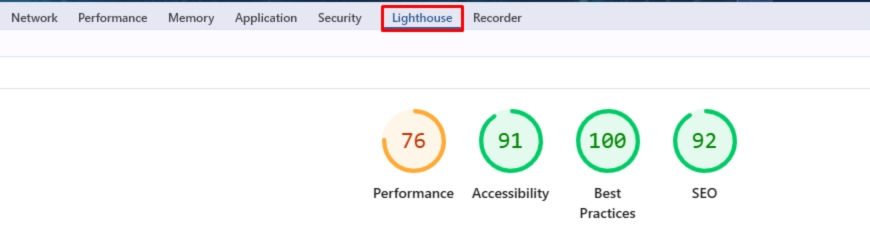
A firm that cannot maintain a fast, well-optimised, conversion-focused website for itself is unlikely to build one for you. This is not a harsh standard; it is the baseline. Run a Google Lighthouse audit on their homepage. Right-click in Chrome, select "Inspect", navigate to "Lighthouse", and click "Analyse page load". Scores below 70 in Performance or SEO are a concern.
3. Treat the portfolio as a starting point, not a decision
Every portfolio is a highlight reel. It shows an agency's best work under the most favourable conditions, with the most cooperative clients, on the projects that went smoothly.
The portfolio is useful, but do not stop there. Go deeper:
- Click through live sites: Do not just look at screenshots. Test load speed, mobile responsiveness, and navigation on your own device.
- Look for industry diversity: A portfolio full of identical-looking sites across different sectors signals a lack of adaptability.
- Ask for performance data: Did a redesign improve conversion rates? Did traffic increase? Did search rankings improve? Agencies willing to share concrete outcomes demonstrate genuine accountability.
- Check whether the work is current: A portfolio featuring sites built five years ago tells you little about present-day standards.
Ask specifically: "Can you show me sites similar to what I need in terms of scope, industry, and objectives?"
4. Demand case studies that show business outcomes
Visual work and business results are different things. A site that looks stunning but converts at 0.5% is not a success story.
Case studies are where strong agencies separate themselves from the rest. Look for write-ups that include:
- The client's challenge or business problem
- The strategic decisions made during the project
- Measurable outcomes, conversion rate lifts, organic traffic growth, page speed improvements, or revenue impact
If an agency's case studies only contain design praise and aesthetic descriptions, push for numbers. If they cannot provide any, that is a clear signal that results are not something they track or prioritise.
5. Understand their discovery process in detail
The discovery phase is where an agency learns your business, audience, competitive landscape, and goals before a single design decision is made. It is what separates strategic web design from aesthetic web design.
Ask directly: "What does your discovery process look like, and what do we produce at the end of it?"
The right answer involves documented outputs, audience research, competitor analysis, sitemap planning, user journey mapping, and strategic recommendations. These documents should inform every design and development decision that follows.
If an agency's answer to this question is vague, or if it jumps straight to asking about colours and fonts, the discovery phase is not genuinely part of their process. Projects built without discovery are almost always rebuilt within three years.
6. Evaluate their SEO integration - Not as an add-on
A website that ranks poorly is invisible. Search visibility is not something to address after launch; it needs to be built into the architecture from day one.

When speaking to agencies, ask:
- "How do you incorporate SEO into the design and development process?"
- "Who on your team handles technical SEO - the designer or a dedicated specialist?"
- "How do you approach page speed, crawlability, and structured data during the build?"
Green flags: SEO is discussed early in the sales process, the agency can explain its approach in plain English, and team members have verifiable SEO knowledge.
Red flag: SEO is presented as an optional add-on or a post-launch service.
Also worth checking: does the agency's own website rank for the services it sells? If a firm offering "web design in Romford" does not appear in local search results, it is not practising what it preaches.
7. Assess their UX credentials - Not just their design aesthetics
User experience (UX) and visual design are related but distinct disciplines. An agency with strong visual design skills and weak UX knowledge will produce sites that look good but fail to guide users towards action.

Look for evidence of a genuine UX process:
- Wireframes and user journey maps that predate visual design work
- A/B testing capability or track record
- Mobile-first design philosophy applied from the start, not adapted after the fact
- Consideration of accessibility standards (keyboard navigation, colour contrast, alt text)
Ask: "How do you map the user journey from landing to conversion before any design work begins?"
If the answer describes visual mockups as the first output, the agency is designing aesthetically, not strategically.
8. Verify their project management process
A well-built website requires structured project management. Without it, timelines drift, revision rounds multiply, scope expands without budget adjustment, and communication breaks down.
Before signing, ask:
- "Who will be my dedicated point of contact throughout the project?"
- "What project management tools do you use, and will I have access?"
- "How are scope changes documented and priced?"
- "What happens if the project falls behind schedule?"
A reliable firm assigns a named project manager, builds realistic timelines with milestone reviews, and handles change requests through a documented process. Vague answers to any of these questions indicate that the structure exists on paper but not in practice.
9. Check their CMS recommendation against your actual needs
The content management system that an agency recommends will affect how easily your team manages the site for years to come. Some agencies default to the platform they know best, regardless of whether it suits the client.
Ask: "What CMS do you recommend for this project, and why?"
The right answer is specific to your requirements, your team's technical ability, your content update frequency, your growth plans, and your budget. A technology-agnostic firm that selects the best tool for the project is preferable to one that uses the same solution for every client.
Also ask: "If you closed tomorrow, could our team manage and update the site independently?" The answer should be yes. Any arrangement where ongoing site access depends on maintaining the agency relationship is a dependency worth avoiding.
10. Scrutinise pricing for transparency and scope Clarity
Web design pricing in the UK varies considerably:
|
Pricing model |
Best for |
Typical range |
|---|---|---|
|
Fixed-price project |
Well-defined scope, clear requirements |
£2,000–£15,000 for SMBs |
|
Hourly billing |
Ongoing or evolving work |
£50–£200/hr |
|
Monthly retainer |
Maintenance, updates, and improvements |
£500–£3,000/month |
|
Value-based pricing |
Strategic projects with measurable impact |
Base fee + performance bonuses |
When comparing proposals, look beyond the headline figure. Understand what is included and what is billed separately. Common extras include content writing, photography, third-party integrations, additional revision rounds, hosting, and post-launch maintenance.
Ask for a detailed scope of work document. If any agency is reluctant to provide one, that reluctance will cost you money later.
11. Read reviews on independent platforms
Testimonials on an agency's own website are curated. They represent the best feedback from the most satisfied clients, written in the most favourable terms.
For a more complete picture, check:
- Google reviews: Look at the overall pattern, not just individual ratings
- Clutch.co: Detailed project-level reviews with budget, timeline, and outcome data
- Trustpilot: Useful for spotting recurring complaints about communication or delivery
- LinkedIn recommendations: Written by named professionals, harder to fabricate
Look for patterns across multiple reviews. Repeated praise for the same strengths confirms consistency. Repeated complaints, particularly about communication, missed deadlines, or post-launch support, indicate systemic issues that a good first impression will not fix.
12. Ask for references and actually contact them
References are one of the most underused evaluation tools in a hiring process. Most business owners ask for them and never follow up.
Contact at least two previous clients and ask:
- Did the project finish on time and within budget?
- How was communication managed throughout?
- Were there any surprises - in cost, timeline, or scope?
- Are you happy with the ongoing performance of the site?
- Would you work with them again?
The last question is the most revealing. A client who says, "The site looks great, but no, I wouldn't use them again" tells you everything.
13. Understand post-launch support before you sign
The launch date is not the finish line; it is the start of ongoing maintenance. Security vulnerabilities, plugin updates, performance degradation, and content changes are all part of running a live website.
Before committing, ask:
- What is included in the post-launch support period, and how long does it last?
- How are bug fixes handled - are they included or billed separately?
- Do you offer ongoing maintenance retainers, and what do they cover?
- Who owns the domain and hosting accounts - the agency or the client?
That last question matters more than most clients realise. Some agencies register domains and set up hosting under their own accounts. Leaving them then becomes a negotiation. Insist that all accounts - domain, hosting, CMS are registered in your name from day one.

14. Watch for these red flags and walk away when you see them
After years of client feedback and project post-mortems, certain warning signs appear consistently before a bad project outcome. Treat these as disqualifying, not negotiable:
Pricing red flags
- A quote significantly below every competitor with no explanation
- Requests for full payment upfront before any work begins
- Pricing with no detailed scope - just a total figure
Process red flags
- No discovery phase before design begins
- Vague or missing timelines with no milestones
- Inability to explain how scope changes are managed
- No QA or testing phase mentioned
Communication red flags
- Taking more than 24 hours to respond to an initial enquiry
- Generic proposals that read as if they were written for anyone
- Pressure to sign quickly ("this rate is only available this week")
Ownership red flags
- The agency registering your domain or hosting under their own accounts
- Contracts where the agency retains intellectual property or source files
- No cancellation clause or disproportionate termination penalties
One red flag is worth investigating. Two or more is a clear signal to move on.
15. Use a scoring matrix to make the final decision objectively
After evaluating three to five agencies, emotion and familiarity can distort the comparison. A structured scoring matrix removes that bias.
Rate each agency from 1 to 10 on these criteria, applying the weights shown:
|
Criterion |
Weight |
|---|---|
|
Portfolio quality and relevance |
20% |
|
Communication and project management |
20% |
|
Technical expertise and approach |
20% |
|
Pricing transparency and value |
15% |
|
Local knowledge and availability |
10% |
|
Client references and testimonials |
10% |
|
Post-launch support capability |
5% |
Calculate a weighted score for each candidate. Then, and this is important, cross-check the top scorer against your gut instinct. Do you trust this team? Do they ask good questions about your business? Do their values align with how you work?
The scoring matrix handles the objective assessment. The instinct check handles the rest. Both matter.
What happens when you choose the wrong agency
This is worth stating plainly, because the consequences are often underestimated.
A poor agency choice typically produces one or more of the following:
- A site that looks acceptable but converts poorly
- Architecture that is hostile to search engines
- A CMS so complex or locked down that internal updates require agency involvement for every change
- Security vulnerabilities from outdated or poorly implemented software
- A build that cannot scale as the business grows
- Hidden costs that emerge after launch
- A complete rebuild within two to three years
The financial cost of rebuilding a site is significant. The opportunity cost, lost leads, lost conversions, and lost ranking positions during the gap are often larger.
Getting this decision right the first time is not a nice-to-have. It is a commercial priority.
Last thoughts
Choosing a web design agency is a commercial decision, not a creative one. The right partner builds around your business objectives, earns your trust through transparency, and delivers a site that performs, not just one that looks good at the pitch stage.
Every tip here points to the same principle: qualify rigorously before you sign. Define your goals. Scrutinise the evidence. Ask the uncomfortable questions. Check ownership terms. Score each firm on what actually matters.
The agencies worth hiring welcome that level of scrutiny. The ones who do not have already told you everything you need to know.
Frequently Asked Questions (FAQs)
Q: How long does it take to build a business website?
A: A standard business website usually takes 4 to 8 weeks from discovery to launch. Simple brochure websites with basic pages and standard CMS platforms move faster because they require less development and fewer integrations. E-commerce websites, booking systems, or custom-built platforms often take 3 to 6 months due to complex functionality, payment gateways, user journeys, and testing requirements. Project timelines also depend on content preparation, feedback speed, revision rounds, and technical complexity.
Q: What is the single most important thing to check before hiring?
A: Their discovery process. An agency that invests time understanding your business, audience, and goals before touching a design tool is far more likely to build something that performs, not just something that looks good.
Q: Should I choose a local or national web design agency?
A: Local agencies offer easier in-person collaboration, local market knowledge, and direct accountability. National or remote agencies may offer deeper specialisation or more competitive pricing. The decision should follow the project’s complexity. Simple local sites often benefit from a local agency relationship. Complex e-commerce or technical builds benefit more from specialist capability than geographic proximity.
Q: What is the difference between a freelance web designer and an agency?
A: A freelance designer typically handles design and basic development but will need to sub-contract or refer out for SEO, copywriting, complex integrations, and ongoing technical maintenance. An agency has multiple specialists under one roof. For straightforward brochure sites on a tight budget, a skilled freelancer can be excellent value. For anything requiring SEO integration, complex functionality, or ongoing strategic support, an agency’s team structure reduces the coordination risk.



Leave a Reply