

A pay monthly website and traditional web design represent two distinct routes for getting a small business online. One runs on a fixed monthly subscription covering everything from design and hosting to security and maintenance. The other is a one-off project fee where the business owns the site outright but handles ongoing costs separately. Speed to market, five-year costs, design flexibility, support and maintenance, SEO performance, and e-commerce capability all sit differently across the two models. Ownership, technical management, and suitability for different business types also differ between them. Each of these comparisons gives a clear idea of which route fits the business and which one costs more in the long run.
What is a pay monthly website?
A pay monthly website is a subscription-based service where design, hosting, security updates, support, and ongoing maintenance sit inside one regular payment. The fee covers website design and build, SSL, email setup, content changes, domain registration, and basic technical care, giving startups and small businesses a flexible, affordable solution for managing cash flow.
Most providers bundle web design, development, hosting, and security into a fixed monthly fee under an agreed contract term, removing the need to handle technical tasks separately. The package typically includes UK-based hosting, software patches, technical support, and minor content amendments, while some agencies extend it with booking systems, contact forms, and basic SEO setup.
Note: Specific inclusions vary by provider. Confirming the full scope before signing is worth the time.

What is traditional web design?
Traditional web design is a project-based approach where a website is built, launched, and often left unchanged for long periods, a model (frequently described as 'set and forget'). It follows a design-first, content-later process involving discovery, wireframes, custom design, development, testing, and launch before the completed site passes to the business owner. The company pays a one-off project fee, owns the final site outright, and then handles hosting, renewals, security patches, and support separately after launch.
This route suits firms wanting a bespoke digital asset, full control over the code, and a more tailored build with advanced integrations. It also fits businesses with larger budgets and an internal resource to manage the site after launch. Bespoke builds move through planning, design approvals, development, and testing stages, a process that typically takes longer before going live. A custom site offers strong design flexibility and full ownership, though that longer timeline often delays lead generation and online visibility for growing businesses.
Pay monthly website or traditional web design – Which option launches faster for your business?
Pay monthly websites launch faster. Because the provider uses proven templates and repeatable workflows, most sites go live within two to four weeks of the initial brief. Traditional builds take considerably longer. The bespoke process of discovery, wireframes, design approvals, development, and testing commonly runs eight to sixteen weeks.
For a business needing an online presence before a product launch or seasonal peak, that gap matters. A site live in three weeks and already generating enquiries outperforms a bespoke build sitting in development for four months, regardless of which looks more impressive in a design presentation. Speed to market is one of the most underreported advantages of the subscription model.
Pay monthly vs traditional web design: 5-year cost comparison
Most competitor content lists monthly costs without running the full five-year numbers. Here is a straightforward calculation for a typical small business site.
Pay monthly at £49/month:
|
Year |
Cumulative Cost |
|---|---|
|
Year 1 |
£588 |
|
Year 2 |
£1,176 |
|
Year 3 |
£1,764 |
|
Year 4 |
£2,352 |
|
Year 5 |
£2,940 |
Note: Hosting, SSL, updates, and support are included throughout.
Traditional one-off at £2,500 upfront:
|
Year |
Cumulative Cost |
Notes |
|---|---|---|
|
Year 1 |
£2,635 |
Upfront + £120 hosting + £15 domain |
|
Year 2 |
£2,770 |
+ £135 ongoing |
|
Year 3 |
£3,705 |
+ £800 plugin overhaul or refresh |
|
Year 4 |
£3,840 |
+ £135 ongoing |
|
Year 5 |
£5,175 |
+ £1,200 redesign or CMS migration |
The subscription model stays cheaper for most small businesses across a five-year window, but only where the monthly fee includes genuine support and proactive maintenance, not just hosting. Always verify what the fee actually covers before committing.
Design and customisation: Where traditional web design has the edge
Pay monthly websites are built on templates and semi-custom frameworks. Drag-and-drop tools make them fast to deploy and straightforward to manage without technical skills. The trade-off is that the design sits within a predefined structure. Pixel-level control over layout, typography, and interaction design is not typically available.
Traditional builds have no such ceiling. A custom site built by a developer uses HTML, CSS, and JavaScript without restriction, and every element is intentional. The result reflects the brand precisely rather than approximately.
For most small businesses (a plumber, an accountant, a freelance photographer, a local retailer), a well-built template-based site performs just as well in search results and converts just as well with customers. The visible difference between a premium template and a fully custom site is minimal when the content, copy, and photography are strong.
For businesses where design differentiation is a genuine commercial advantage (luxury brands, creative agencies, high-end hospitality), a custom build delivers something templates cannot replicate.
Support and maintenance: Where pay monthly websites have the edge
Post-launch support is where pay monthly creates its clearest practical advantage for non-technical owners. Technical issues get reported to the provider and fixed. Security patches are applied automatically. The CMS stays updated. If a plugin breaks or the site goes down, it is the provider’s problem to resolve.
With an upfront build, that responsibility falls entirely on the owner. A developer needs to be hired, briefed, and paid. If the original agency is no longer trading - which happens - finding someone familiar with the existing codebase takes time and budget. An unmaintained site accumulates security vulnerabilities quietly, and most owners do not notice until something breaks.
The businesses least equipped to handle this, small operators without an in-house technical resource, are precisely the ones most likely to let maintenance slip. The subscription model removes the problem entirely.
Pay monthly vs traditional web design: Does your website model affect SEO rankings?
Yes, the website model a business chooses affects SEO rankings, but the impact comes from technical quality and content performance, not from the payment structure itself. Search engines rank pages based on speed, mobile responsiveness, clean code, crawlability, and topical relevance. A well-built pay monthly site performs just as strongly in search results as a bespoke build when those fundamentals stay properly in place.
Traditional builds hold an advantage in technical SEO flexibility. Developers working on a custom site control, site architecture, structured data, Core Web Vitals optimisation, and server-side rendering without platform restrictions. Subscription-based platforms apply sensible defaults, but the ceiling on advanced technical customisation is lower.
For most UK small businesses targeting local searches, "plumber in Bristol" or "accountant in Manchester", that ceiling rarely affects rankings. Local SEO depends far more on Google Business Profile quality, customer reviews, consistent NAP (Name, Address, Phone Number) details, and relevant service content. Businesses targeting competitive national or international markets, where marginal technical gains matter, get more headroom from a custom build.
Pay monthly or traditional web design for ecommerce: Which works better?
Pay monthly platforms are well suited to straightforward ecommerce websites. A local retailer selling a modest product range, a trades business selling merchandise, or a service provider selling digital downloads gets everything needed from a subscription package: product listings, a shopping cart, payment gateway integration (Stripe, PayPal), and inventory basics.
Complex retail requirements are a different matter. Bespoke pricing logic, multi-warehouse inventory, custom checkout flows, wholesale portals, or deep integration with third-party systems all need custom development. A pay monthly framework is not built for that level of specificity.
The practical test: if Shopify or WooCommerce with standard plugins meets the business’s needs, pay monthly is a viable route. If the business needs something those platforms cannot do off the shelf, a custom build is the appropriate choice.
Who is a pay monthly website best for?
A pay monthly website works best when the priority is getting online quickly, keeping costs predictable, and avoiding the overhead of managing a site independently. The following business types get the strongest return from the subscription model.
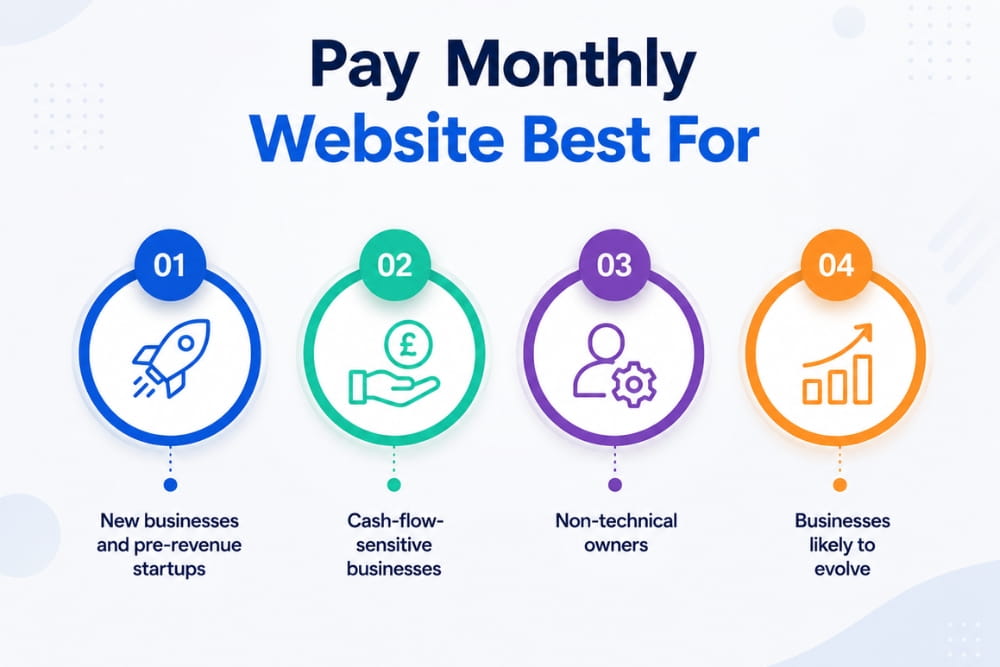
- New businesses and pre-revenue startups: Spending £3,000–£5,000 on a website before the first customer has paid is a high-risk use of limited capital. A subscription site at £50/month gets the business online professionally without draining the launch budget.
- Cash-flow-sensitive businesses: Seasonal trades, project-based consultancies, and businesses with variable income benefit from fixed, predictable monthly costs rather than irregular capital expenditure.
- Non-technical owners: Business owners with no interest in managing hosting panels, plugin updates, and security certificates get a fully managed service. The website runs. That is all they need to know.
- Businesses likely to evolve: A startup in 2026 may look completely different by 2028. Pay monthly sites are easier to adapt, rebrand, or replace than a bespoke build that the owner has paid thousands to develop.
Who is traditional web design best for?
Traditional web design makes commercial sense when the business has specific requirements a standard platform cannot meet, or when outright ownership of the digital asset is non-negotiable. The following businesses consistently get the better long-term outcome from the upfront route.
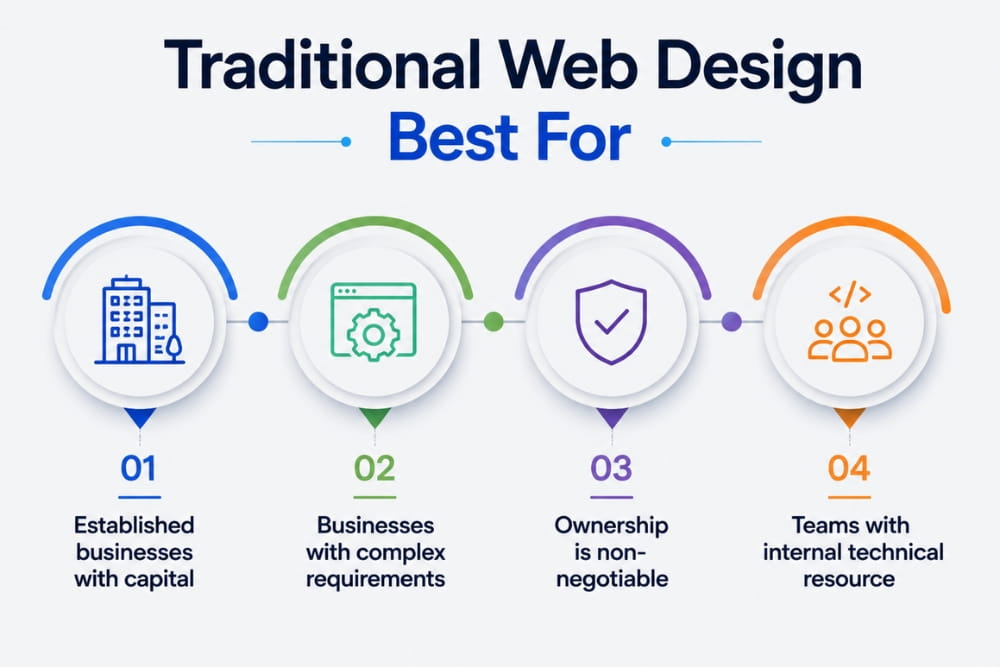
- Established businesses with capital: A business with £3,000–£5,000 available and stable, predictable income gets a long-term asset it owns outright. Over a decade, with disciplined internal maintenance, the economics favour the upfront model.
- Businesses with complex requirements: Custom integrations, industry-specific portals, multi-location e-commerce, or functionality that no off-the-shelf platform covers, these need bespoke development. There is no monthly package equivalent.
- Businesses where ownership is non-negotiable: Some owners will not operate on a model where the site disappears if payments stop. For them, the upfront model removes that dependency entirely.
- Teams with internal technical resource: A business with a developer or technically capable marketing manager on staff manages hosting, updates, and maintenance without paying for a support package. The running costs of an owned site drop significantly with in-house capability.
Last thoughts
Neither model is the wrong choice. A pay monthly website suits businesses that need to get online fast, keep costs predictable, and hand off technical responsibility to a provider. Traditional web design suits those with the budget to invest upfront, the need for a fully custom build, and the internal resource to manage the site after launch. The better model is always the one that fits the business, not the one that looks most impressive on paper. For most UK small businesses, startups, and tradespeople, the subscription route delivers more value, faster. For firms with complex requirements and long-term ownership goals, the upfront build remains the stronger investment.
Frequently Asked Questions (FAQs)
Q: Does a pay monthly website affect my SEO compared to a traditionally built site?
A: Yes, a pay monthly website affects SEO, but the impact comes from technical quality and content performance, not the payment structure itself. A well-built pay monthly site ranks just as strongly as a bespoke build when speed, mobile performance, and on-page content are properly managed. Traditional builds offer more advanced technical customisation, which matters for competitive national markets but rarely affects local search performance.
Q: What happens to my website if I stop paying the monthly fee?
A: The site goes offline. Content, text, images, and copy remain yours and can be exported. The design and hosting infrastructure belong to the provider.
Q: Can I switch from pay monthly to owning my website later?
A: Yes, some providers offer a buyout option where a one-off fee transfers full ownership of the design and files. Others operate a rent-to-use model where the site cannot be moved if the subscription ends. Always confirm ownership terms and buyout options in writing before signing any contract.
Q: How long does a pay monthly website take to build?
A: Most providers deliver a standard small business site within 2 to 4 weeks of receiving the brief and content. Complex builds with custom functionality take longer, regardless of payment model. Traditional bespoke builds typically run eight to sixteen weeks from brief to launch.
Q: Do I own my domain name with a pay monthly package?
A: Yes, in most cases, the domain is registered in the business's name and remains the business's property. Always confirm this explicitly with the provider before signing, as a domain registered in the agency's name creates a dependency that is difficult and disruptive to unwind later.
Are pay monthly websites good for small businesses?
Yes. They suit smaller firms that want a professional site without a large upfront bill. They also reduce technical workload by bundling hosting, maintenance, and support.
Q: Are traditional websites cheaper in the long run?
A: Yes, a traditionally built site often works out cheaper over a ten-year period for businesses with the upfront capital and internal resource to manage ongoing maintenance. Over a five-year window, however, a pay monthly site at £49/month stays cheaper than a £2,500 upfront build once hosting, renewals, and periodic redesign costs are factored in. The better value depends on how long the business plans to keep the site and who manages it after launch.
Q: Do pay monthly websites include hosting?
A: Yes, hosting is included in virtually every pay monthly package, alongside SSL, security updates, and technical support. That bundle removes the need to manage hosting separately and is one of the main reasons small businesses and tradespeople choose the subscription model over an upfront build.
Q: Which option gives full ownership?
A: Traditional web design gives full ownership after payment. A pay monthly model gives access for as long as the service stays active.



Leave a Reply