
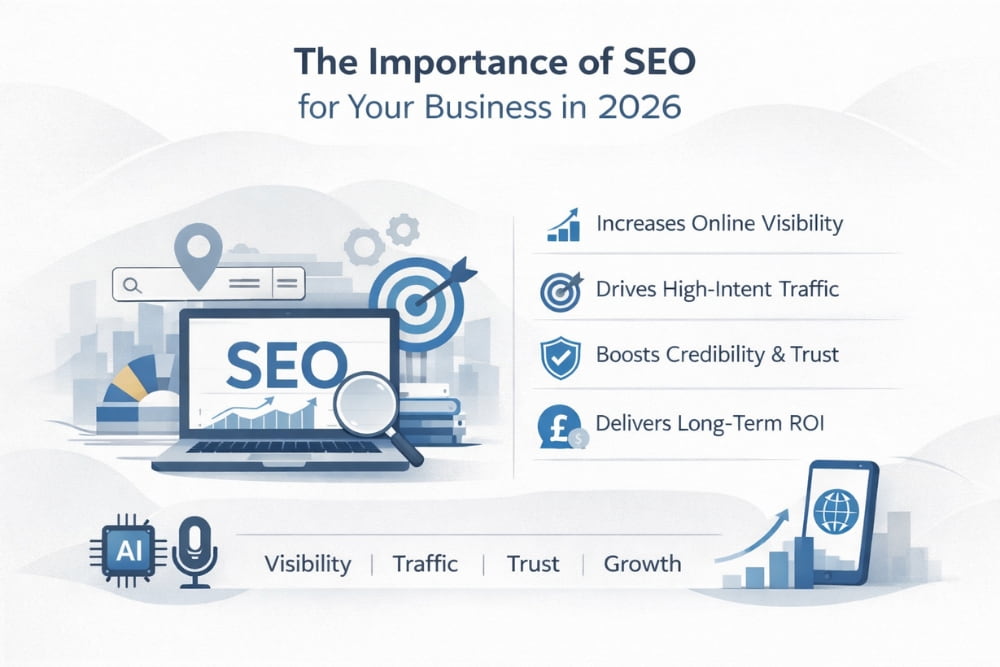
Search in 2026 focuses on intent, credibility and structured data. In the UK, customers use Google to compare providers, read reviews and make decisions before they contact a company. When someone searches for a local accountant in Manchester or a web design agency in London, visibility at the right moment directly affects revenue.
SEO (Search engine optimisation) improves a company’s online presence by helping search engines understand, rank and present its website to users who actively seek relevant services. It increases visibility in competitive UK markets, attracts high-intent traffic and matches content to user needs to improve conversions. It also reduces dependence on paid advertising, lowers acquisition costs and delivers measurable long-term returns.
This strategy supports customers at every stage of the buying journey, builds trust and develops clear authority within a specific industry. Strong rankings create a competitive advantage and expand brand exposure across multiple platforms. Technical improvements enhance user experience, strengthen mobile performance and improve local search presence across the UK.
The same approach prepares businesses for AI-driven and voice search, aligns marketing activity across channels and reveals valuable market insights. Over time, it supports structured expansion and drives sustainable commercial growth.
.jpg)
1. SEO Improves Visibility in Competitive UK Markets
The UK digital market is highly competitive, especially in sectors such as professional services, e-commerce and home improvement. Businesses that appear on the first page of Google gain significantly more exposure because most users do not look beyond the top results.
Well-optimised service pages target high-intent searches, and informative guides answer early research queries. This structure increases search presence across multiple entry points and strengthens brand recognition during the decision process. Companies operating in specific regions also benefit from local optimisation, which increases prominence in map listings and location-based searches.
2. SEO Drives High-Intent Organic Traffic
Search optimisation attracts users who already need a solution. When people search for a service, they show clear intent. They look for answers, not interruptions.
Businesses that align each page with a defined intent, informational, comparative or transactional, attract visitors who are more likely to convert. For example:
- Informational content supports early research.
- Comparison pages guide evaluation.
- Service pages generate direct enquiries.
This approach reduces wasted traffic and improves conversion efficiency. Over time, organic traffic often delivers stronger returns than paid advertising because costs do not rise with every click.
3. SEO Improves Conversion Rates by Matching Search Intent
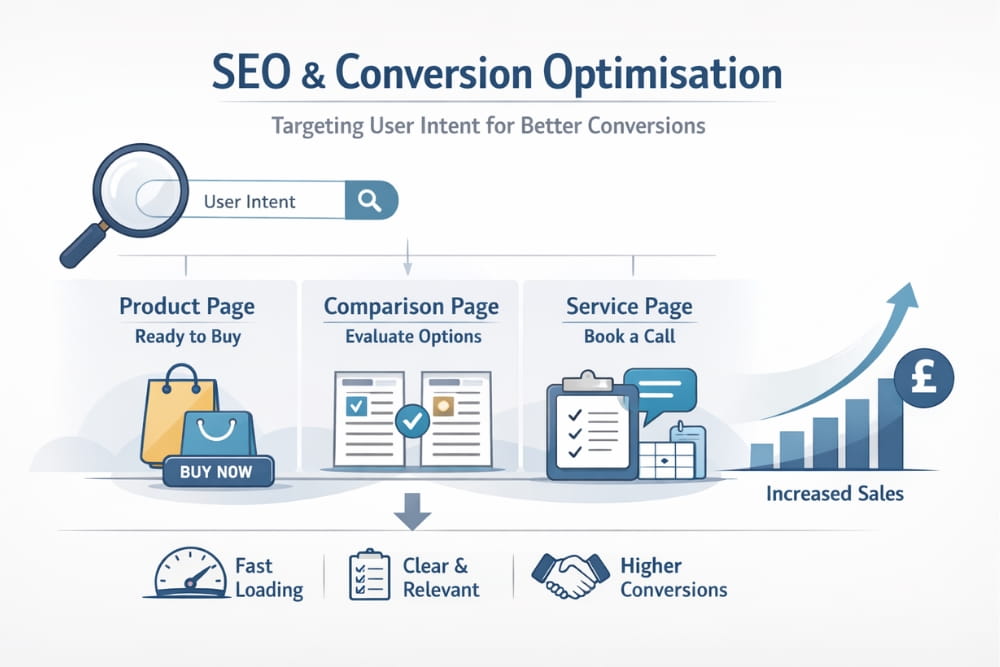
Visibility alone does not produce revenue; relevance does. Effective optimisation aligns each landing page with a specific user need.
A user searching for pricing expects clear costs. Someone comparing providers looks for proof, case studies and reviews. A ready-to-buy prospect wants fast access to contact details and service information.
Businesses that structure pages around these expectations remove friction from the buying journey. Fast load times, simple navigation and clear messaging help users move from research to enquiry. When content directly answers intent, conversion rates increase naturally.
4. SEO Lowers Long-Term Acquisition Costs
Paid advertising costs continue to rise across UK industries. Although paid campaigns generate quick traffic, they require ongoing spend to maintain visibility.
Organic search works differently. Pages that achieve stable rankings continue to attract enquiries without a cost per click. This makes it one of the most cost-effective growth channels over time.
Companies that invest in structured content, technical improvements and authority building create long-term digital assets. These assets continue to generate leads after publication and reduce reliance on paid media.
5. SEO Helps Customers Find You at Every Stage
Modern buyers research before they commit. They compare options and assess credibility before contacting a provider.
Search optimisation allows your business to appear at each stage of that journey:
- Educational articles build awareness.
- Comparison pages support evaluation.
- Service pages capture high-intent enquiries.
This structured presence builds familiarity and trust. By the time prospects make contact, they understand your offer and feel more confident in their decision.
6. SEO Delivers Measurable, Long-Term ROI
Search optimisation delivers stronger results over time than short-term campaigns. As domain authority grows and content gains visibility, organic traffic becomes more stable and predictable.
In competitive UK sectors, sustained rankings reduce reliance on fluctuating advertising budgets and support consistent lead generation.
When teams measure performance against lead quality, conversion rate and customer lifetime value, this channel often outperforms short-term traffic tactics. It supports long-term commercial growth through measurable benchmarks delivered by professional SEO services in the UK and clear reporting.
7. SEO Strengthens Brand Credibility
Higher search rankings signal authority. When users see your website near the top of the results, they trust it more before they even click.
Credibility increases when a website shows:
- Clear author attribution and transparent business information
- Backlinks from relevant publications
- Structured content that demonstrates expertise
These signals match Google’s quality standards and show real competence. This trust often influences purchasing decisions in regional UK markets as much as pricing does.
8. SEO Builds Topical Authority in Your Industry
Search engines prioritise websites that demonstrate consistent expertise within clearly defined subject areas. When you organise content into thematic clusters around core services and related queries, you strengthen semantic relevance across the site.
This approach improves how search systems interpret contextual relationships between pages. Over time, deeper topical coverage enhances entity recognition and reinforces ranking stability in competitive UK search environments.
9. SEO Creates Sustainable Competitive Advantage
Many UK industries compete at both local and national levels. Companies target the same high-value search terms across London, Manchester and Birmingham.
Strong search positioning allows a business to secure priority service keywords before competitors gain visibility. As rankings stabilise, competitors face greater difficulty displacing established results.
Search performance data also reveals underserved gaps in the market. Organisations that act early on these opportunities strengthen their market position and increase competitive resilience.
10. SEO Increases Brand Visibility Across Platforms
High-ranking pages often become reference points within an industry. When authoritative content earns backlinks and engagement, it gains exposure beyond search engines.
Teams can adapt well-structured material into:
- LinkedIn thought leadership posts
- Educational newsletters
- Industry commentary
- Short-form video summaries
Businesses that base content on real search demand create messaging that matches what audiences actively seek and discuss.
11. SEO Improves User Experience and Technical Performance
Search optimisation goes beyond content updates. Technical performance directly affects rankings and user behaviour.
Key factors include:
- Fast loading times allow users to access information without delay.
- Mobile-first optimisation ensures content performs effectively across devices.
- Clear navigation helps visitors find key information quickly.
- Secure browsing (HTTPS) protects data and builds trust.
- Strong Core Web Vitals improve interaction quality and reduce user frustration.
Mobile usage dominates many UK sectors. Websites that load quickly and present information clearly lower bounce rates and increase engagement. When visitors find answers without difficulty, they convert more often.
Technical improvements deliver the best results when supported by a fast, conversion-focused website. For this reason, many companies combine search optimisation with strategic web design enhancements.
12. SEO Strengthens Mobile Performance
Google uses mobile-first indexing, which means it prioritises the mobile version of a website when evaluating rankings.
UK users frequently browse and purchase on smartphones. Mobile usability, therefore, plays a direct role in conversion performance.
Effective optimisation includes:
- Responsive design
- Compressed images
- Clean layouts
- Minimal intrusive elements
- Clear call-to-action placement
A smooth mobile experience supports rankings and prevents users from leaving due to friction.
13. SEO Strengthens Local Search Presence in the UK
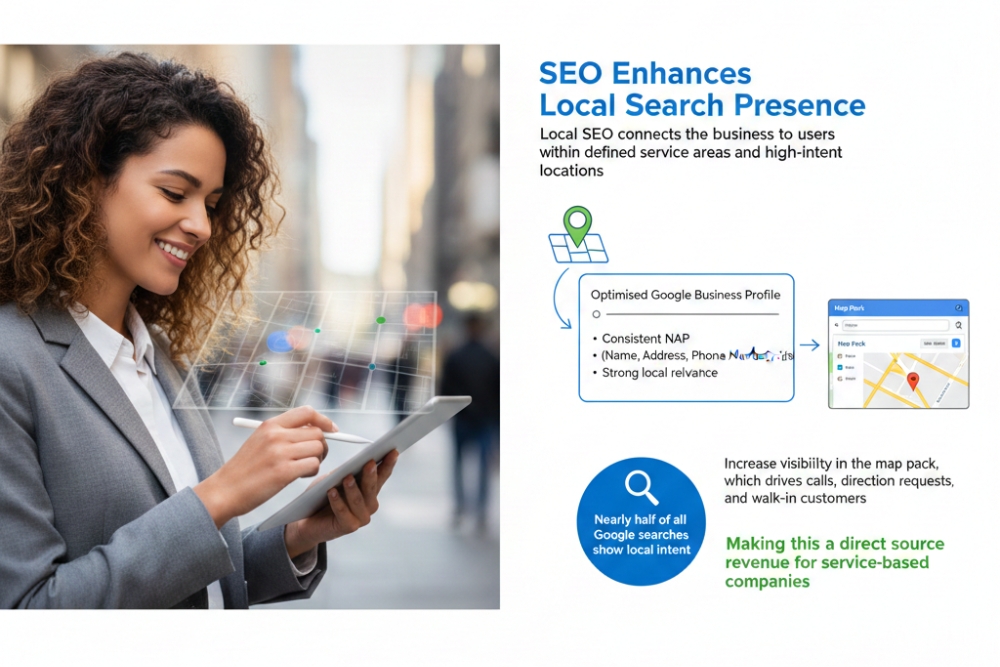
Local search continues to grow across the UK. Many users include location terms when searching for trades, legal services or healthcare providers.
Effective local optimisation includes:
- A fully optimised Google Business Profile
- Consistent Name, Address and Phone Number (NAP) details
- Location-specific service pages
- Genuine client reviews
- Relevant local backlinks and citations
Companies operating in cities such as London or Leeds gain higher engagement when they appear in the map pack. Accurate and consistent local signals help search engines confirm legitimacy and reward businesses with stronger regional visibility.
14. SEO Supports Visibility in AI-Driven and Voice Search
AI-driven systems now summarise answers directly within search results. Voice assistants also deliver spoken responses instead of listing multiple links.
Structured content and clear schema markup help these systems understand your business correctly. This clarity increases the chance of appearing in AI-generated summaries and featured results.
Voice queries often follow natural language patterns. Businesses that answer conversational questions improve their visibility in spoken search results. UK companies that maintain structured, authoritative content remain visible as search technology continues to evolve.
15. SEO Strengthens Multi-Channel Marketing Performance
Search data provides insights beyond traffic numbers. Keyword research shows how customers describe problems, compare solutions and signal buying intent.
This information shapes:
- Paid advertising messaging
- Email campaign themes
- Social media content
- Landing page structure
Teams that align messaging across channels create consistency and improve attribution accuracy. Rather than working in isolation, this strategy integrates with the wider work of a UK digital marketing agency and strengthens overall performance.
16. SEO Provides Actionable Market Insights
Search data reflects real behaviour. Businesses that analyse queries, click patterns and conversion paths identify emerging demand.
In the UK market, this analysis can reveal:
- Regional differences in service demand
- Rising niche search terms
- Seasonal buying trends
- Weaknesses in competitor coverage
A regional accounting firm in the Midlands, for example, may identify growing interest in specialist tax advisory searches. It can then create targeted service pages before competitors respond. Companies that base expansion decisions on measurable search behaviour reduce risk and improve planning when entering new regions or launching services.
17. SEO Enables Sustainable and Scalable Expansion
As domain authority increases, ranking new service pages becomes easier and more predictable. This progress creates a compounding growth effect.
A UK business that ranks well in one region can expand into additional cities by building structured location pages supported by internal links.
Unlike short-term campaigns, this approach creates a scalable framework. New content strengthens existing authority and reinforces overall site visibility. This makes search optimisation particularly valuable for organisations planning regional or national growth.
What Is SEO?
Search engine optimisation (SEO) improves a website’s visibility in organic search results. It strengthens technical performance, refines content and builds authority signals so search engines can understand and trust your business.
When businesses apply it correctly, they appear in front of users who actively search for relevant services, products or information. Unlike paid advertising, organic visibility continues to attract traffic without ongoing cost per click.
What Are the Core Elements of SEO?
The key elements of SEO are on-page relevance, technical performance, off-page authority, user experience, and search intent alignment.
On-page work uses clear headings, focused keywords and helpful metadata to match queries with direct answers. Technical improvements allow search engines to crawl pages efficiently, load them quickly and access secure versions of the site. Backlinks from reputable sources signal credibility and strengthen authority. Intent-driven content ensures each page addresses a specific user need and supports stable rankings in competitive results.
What Are the Common SEO Mistakes UK Businesses Should Avoid?
Many companies weaken performance by stuffing keywords or ignoring user intent. Slow page speed and poor mobile optimisation also reduce visibility.
Other common errors include publishing outdated material, creating duplicate pages, neglecting internal links and failing to manage a Google Business Profile for local visibility. These mistakes damage rankings and disrupt user experience.
Businesses that correct these issues protect long-term visibility, maintain steady traffic and reduce the risk of penalties.
When Should a UK Business Invest in SEO?
UK businesses should invest in search optimisation when growth depends on online enquiries, regional exposure or national brand presence.
Companies benefit most when:
- Paid advertising costs continue to rise
- Competitors dominate key search results
- Lead quality from other channels declines
- Expansion into new UK regions becomes a priority
A structured strategy stabilises enquiry flow, improves lead quality and strengthens market position over time. In competitive UK sectors, search visibility now acts as a strategic requirement rather than an optional marketing tactic.



Leave a Reply